Healthcare inequity among people with dementia in Gipuzkoa: a retrospective cross-sectional population-based study
Laburpena
Objective
To compare the use of healthcare resources among the Gipuzkoa population with and without dementia.
Method
A retrospective, cross-sectional cost study was conducted on the entire population over 60 years of age registered with the Basque Health Service. We measured the use of health services (hospital and primary care) and health needs as a function of the presence of dementia and neuropsychiatric symptoms, adjusting for age, sex and comorbidity. Generalised linear models from the Tweedie family distribution were fitted, taking into account the asymmetric distribution of costs.
Results
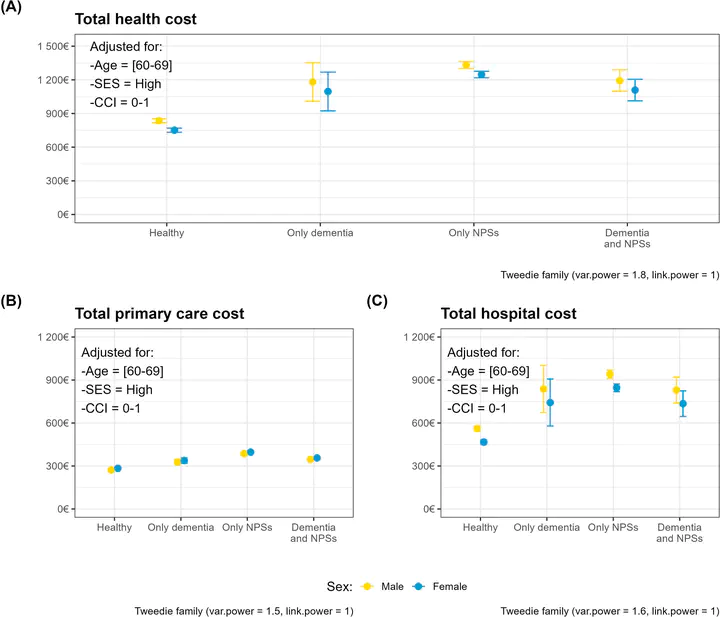
Of the 215,859 over-60-year-olds in Gipuzkoa registered, 7553 (3.5%) had dementia. The median (interquartile range) cost was €743 (241-1682) for the total population, broken down into €722 (241-1660) for individuals without dementia and €1090 (481-2140) for those with dementia. In the Tweedie models adjusted for need, the estimated costs were €496 for the group with only neuropsychiatric symptoms, compared to €358 for the group with both conditions.
Conclusions
When healthcare resource use is adjusted for need, people with dementia receive less care than those without. However, it is difficult to determine whether this is harmful, depriving people with dementia of necessary care (inverse care law), or beneficial, sparing them from unnecessary treatment (overuse).
Key words
Dementia; Health inequities; Gender equity; Healthcare costs; Behavioral symptoms; Social stigma
Hemen artikuluari lotutako Material Osagarria eta kodigo errepositorioa.
Lore Zumeta Olaskoaga
Bioestatistika ikerlaria
Nire ikerketa-interesak, estatistikaren baitan, biziraupeneko analisia, eredu mixtoak eta GAM ereduak dira.