Safety and efficacy of Nordic walking training in adult patients with asthma: A pilot randomised controlled trial with a mixed-methods approach
Abstract
Introduction
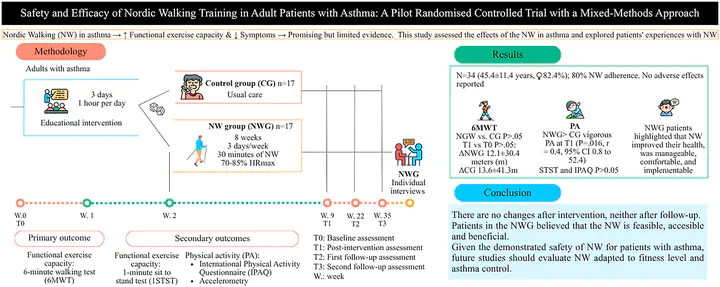
Nordic walking (NW) may benefit patients with asthma by enhancing functional exercise capacity and reducing symptoms, though evidence remains limited. This study assessed NW safety and effects in patients with asthma and explored their experiences.
Methods
A mixed-method two-arm, parallel, pilot randomised controlled trial was conducted in A Coruña between (July 2021 - May 2025). Adults with asthma attended three educational sessions before randomization to NW group (NWG) or control group (CG). The NWG performed NW 3 days/week, during eight weeks, at 70-85% of maximum heart rate. Both groups maintained usual care. The primary outcome was the 6-min walking distance (6MWD). Secondary outcomes included 1-min Sit-to-Stand Test, physical activity (PA) and adverse events. Experiences were explored through individual interviews.
Results
Thirty-four participants with asthma (mean ± SD age 45.4 ± 11.4 years, 82.4% female) were randomly allocated to NWG (n = 17) or CG (n = 17). NW adherence was 80.1 ± 16.1%. No adverse effects occurred. Post-intervention, the NWG increased 6MWD by 12.1 ± 30.4 m (P = .119), whereas the CG decreased by 13.6 ± 41.3 m (P = .193), without significant between-groups differences (P = .067; Cohen’s d = 0.7; 95% confidence interval (CI) 0.0–1.3). The NWG spent more time in vigorous PA compared to CG (P = .016, r = 0.4, 95% CI 0.8–52.4). All NWG participants recommended NW, citing health improvements and finding it manageable, comfortable, and implementable.
Conclusion
Although between-groups differences were not significant, NW was safe, feasible, accessible and perceived as beneficial by individuals with asthma. Given the demonstrated safety, future studies should tailor NW intensity to fitness and asthma control levels.
Highlights
- Nordic Walking is safe and feasible for patients with asthma.
- Participants in Nordic Walking group improved in clinically important outcomes.
- Nordic Walking is a feasible and well-accepted exercise for people with asthma.
- Nordic Walking is a viable alternative to conventional pulmonary rehabilitation.
- Future studies should tailor intensity to different fitness and control levels
Find here the Supplementary Material of the paper.

Lore Zumeta Olaskoaga
Biostatistician, PhD
My research interests include survival analysis, mixed models and GAMs.