Medication for subcutaneous administration: Microbiological and physicochemical stability of drug formulations prepared in advance and stored in syringes
Abstract
Background
The subcutaneous (SC) route is used routinely in patients with advanced diseases requiring palliative care. Pre-prepared individual doses of medication stored in syringes may facilitate home administration for symptom management; however, there are limited data on the microbiological and physicochemical stability of such formulations.
Objectives
To assess the microbiological and physicochemical stability of the pre-prepared formulations stored in syringes for SC administration.
Design
Experimental study of the microbiological and physicochemical stability of pre-filled syringes during storage.
Methods
Standardised methods of medication preparation were followed for morphine, midazolam, metoclopramide, hyoscine butylbromide, levomepromazine, haloperidol, ondansetron, fentanyl, ketorolac and dexamethasone, as well as drug mixtures (morphine + midazolam and midazolam + levomepromazine). Microbiological stability of morphine, midazolam, metoclopramide, butylbromide and drug mixtures was analysed by culture on conventional media and monitoring growth over 14 days. A total of 200 syringes were analysed. Physicochemical stability was assessed using ultra-high-performance liquid chromatography with ultraviolet detection coupled to a mass spectrometer, pH measurement and visual macroscopic examination, with measurements taken at eight time points, of the formulations stored in capped polypropylene syringes in air-tight bags in the dark at room temperature (22±3°C) for 12 weeks.
Results
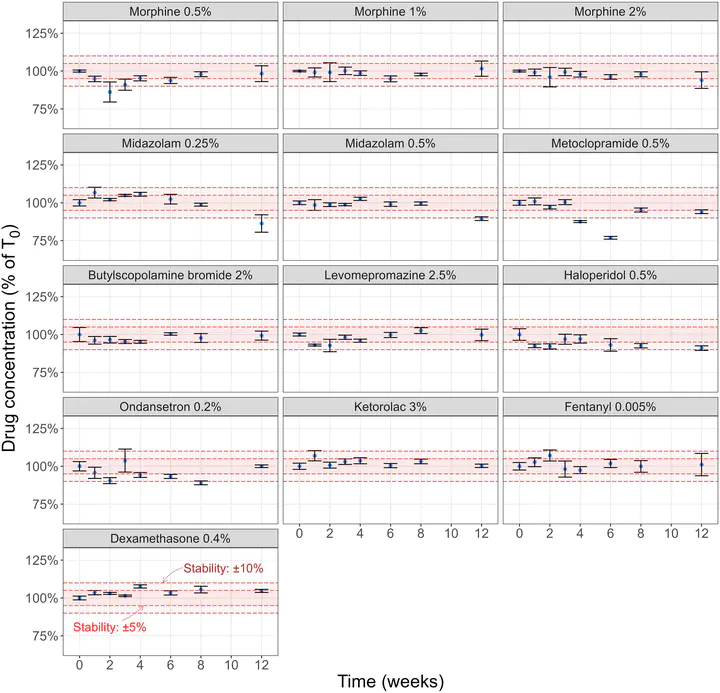
In the microbiological stability analysis, all cultures studied were negative. In the physicochemical stability analysis, the formulations studied retained at least 90% of the initial drug concentrations for 12 weeks, except in the case of metoclopramide (for 3 weeks) and showed no significant changes in pH or macroscopic signs of degradation.
Conclusion
Formulations aseptically prepared and stored in syringes are microbiologically and physicochemically stable for 12 weeks in the cases of almost all drugs studied, the exception being metoclopramide (which was stable up to week 3). These findings suggest that such formulations show stability characteristics consistent with suitability for SC administration of drugs in palliative home care.
Key words
drug stability, UPLC, medication storage, polypropylene syringes, morphine, fentanyl, midazolam, metoclopramide, ondansetron, hyoscine butylbromide, levomepromazine, haloperidol, ketorolac, dexamethasone
Find attached in the article the Supplemental Material.

Lore Zumeta Olaskoaga
Biostatistician, PhD
My research interests include survival analysis, mixed models and GAMs.