Early parental mental health and postnatal bonding as predictors of neurodevelopmental outcomes in very preterm or very low birth weight infants: A three-year prospective study
Abstract
Background
Infants born very preterm (VPT) or with very low birth weight (VLBW) are at increased risk of neurodevelopmental difficulties. While biomedical predictors have been extensively studied, less is known about early psychosocial factors, particularly parental mental health and postnatal bonding.
Aim
This study examined parental mental health, postnatal bonding, sociodemographic, and biomedical predictors of neurodevelopment during the first three years in VPT/VLBW infants.
Methods
This prospective longitudinal study included 114 VPT/VLBW infants and their parents. Predictors included neonatal, sociodemographic, and obstetric factors, as well as psychopathology, postpartum depression, anxiety, and postnatal bonding, assessed during the neonatal intensive care unit (NICU) stay. Neurodevelopment was assessed at 12, 24, and 36 months using the Bayley Scales of Infant and Toddler Development, Third Edition. Linear mixed-effects models were fitted for cognitive, receptive and expressive language, and fine and gross motor domains.
Results
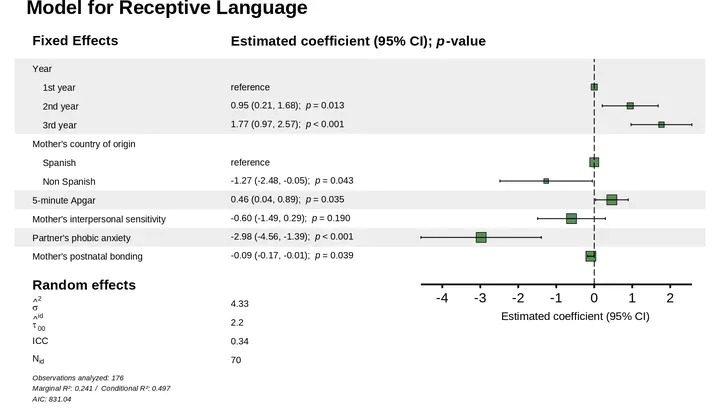
Greater partner phobic anxiety and maternal postnatal bonding difficulties were associated with poorer cognitive and language outcomes. Maternal interpersonal sensitivity was negatively associated with expressive language, whereas maternal paranoid ideation was associated with poorer fine motor outcomes. Maternal foreign origin was associated with poorer language outcomes. Among biomedical factors, infant female sex was associated with better fine motor outcomes, longer NICU stay with poorer gross motor outcomes, and higher 5-min Apgar scores with better receptive language outcomes.
Conclusions
Neurodevelopment in VPT/VLBW infants was associated with both biomedical and psychosocial factors. Findings highlight the relevance of parental mental health and postnatal bonding, supporting an integrative approach to early monitoring and support.
Key words
Very preterm infants; Very low birth weight; Neurodevelopment; Parental mental health; Postnatal bonding; Neonatal intensive care unit; Psychosocial factors
Find here the Supplementary Material and the accompanying code repository for the paper.

Lore Zumeta Olaskoaga
Biostatistician, PhD
My research interests include survival analysis, mixed models and GAMs.