Comparative proteomic analysis of the composition of dECM and dECM-based inks compared to native tissues
Abstract
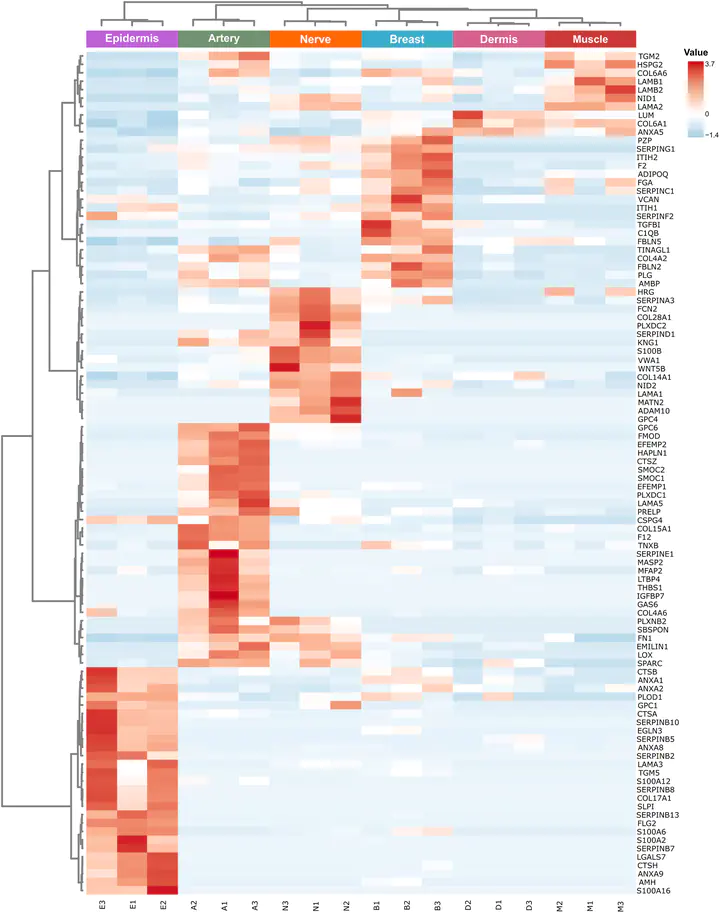
Regenerative medicine and tissue engineering approaches based on decellularized extracellular matrix (dECM) present the advantage of a relatively biomolecule-rich matrix that directs cell function in a tissue-specific manner. To evaluate compositional changes during standard ink processing, six porcine tissues (artery, breast, dermis, epidermis, muscle, and nerve) were independently decellularized and formulated into biocompatible inks, tracking matrisome complexity via comparative liquid chromatography-tandem mass spectrometry (LC-MS/MS). Results revealed a core matrisome found overlapping in all decellularized tissues, alongside tissue-specific components correlating with predicted functional definitions. Although the proportion of collagens (mostly the α1 chains of collagen type I and III) increased in the final inks, a median of 55 matrisomal proteins was detected. This complexity is far superior to non-dECM-based inks in terms of mimicking native tissues. Our results support the use of dECM-based inks and biomaterials in mimicking native tissue ECM complexity, demonstrating tissue-specific composition, which can improve future therapeutic approximations.
Key words
3D bioprinting; decellularization; ECM; liquid chromatography-tandem mass spectrometry; LC-MS/MS; ink composition
Find here the Supplementary Material.

Lore Zumeta Olaskoaga
Biostatistician, PhD
My research interests include survival analysis, mixed models and GAMs.